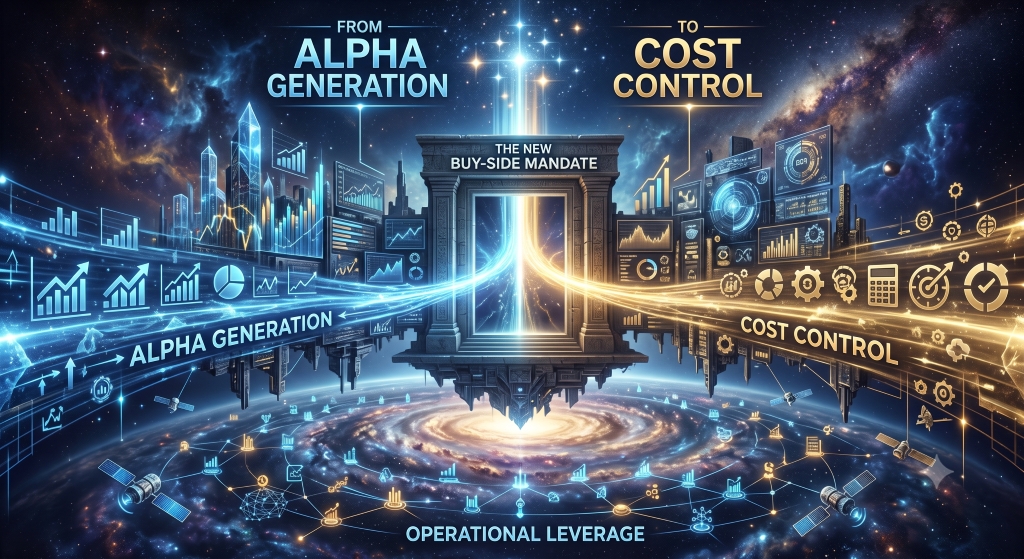


For decades, the buy-side playbook was beautifully simple: chase outsized returns, out-maneuver the benchmark, and the assets will follow. In this alpha-centric world, operational expenses were often treated as a secondary concern—a cost of doing business that healthy management fees could easily absorb.
But the economic landscape has fundamentally shifted. We are now operating in a market defined by relentless fee compression, structural shifts toward low-cost passive vehicles and active ETFs, and rising regulatory burdens. Today, generating alpha is only half the battle. The true differentiator between a thriving asset manager and one caught in the industry’s "Valley of Death" is operating leverage—the ability to scale operations and assets without a proportional increase in costs.
The buy-side has a new mandate: operational efficiency is no longer just a support function; it has become a core investment strategy.
Many executives hoped that the market rallies of recent years would permanently lift margins. However, data tells a different story. According to a recent BCG report, more than 80% of gross revenue growth in asset management has been propped up by market appreciation rather than organic new inflows.
Beneath the surface, margins are under pressure due to several permanent shifts:
To thrive under this new mandate, leading buy-side firms are actively "re-piping" their operating models. Cost control is no longer about arbitrary budget cuts or hiring freezes; it is about architectural modernization.
Legacy Model:      More Assets Under Management ➔ Scale Headcount ➔ Shrinking Margins
Modern Buy-Side:   More Assets Under Management ➔ AI-Driven Automation ➔ Fixed Cost Base
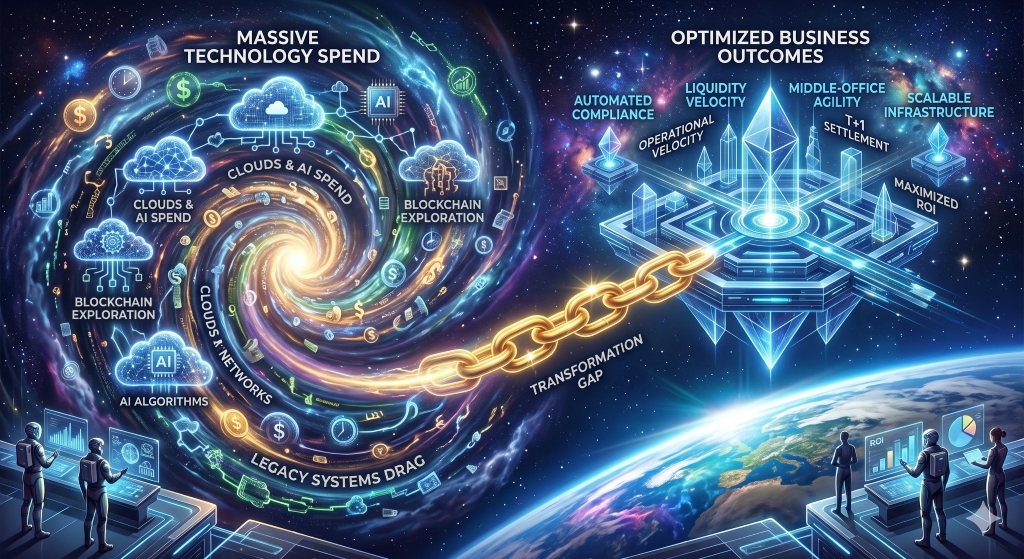
Rather than building custom, isolated platforms for every new asset class, future-fit firms are consolidating their technology stacks. They are aggressively outsourcing non-core functions—such as post-trade processing, data reconciliation, and localized compliance monitoring—to specialized providers. This allows investment teams to focus strictly on what they do best: managing risk and finding yield.
Artificial Intelligence has officially graduated from a front-office curiosity to a back-office necessity. While early AI projects focused heavily on searching for alpha signals, the most profound return on investment (ROI) is happening in enterprise-level automation.
Modern, AI-first asset managers are deploying technology to eliminate the manual friction points that trigger operational leaks. This includes using generative AI and advanced machine learning to automate complex data ingestion from unstructured broker documents, streamline client onboarding, and handle instant cross-border post-trade adjustments. By creating an infrastructure where data moves seamlessly across the trade lifecycle, firms can absorb massive influxes of new capital at a marginal cost that trends toward zero.
The firms that will dominate the next decade understand a fundamental truth: a dollar saved through structural operational efficiency is just as valuable as a dollar generated through market returns.
By treating cost control and operational modernizing with the same strategic rigor historically reserved for investment committee meetings, buy-side leaders can insulate their businesses from market volatility, protect their margins, and build an agile foundation engineered for a new era of finance.
BA Blocks
Industry Certification Programs:
CFA(Chartered Financial Analyst)
FRM(Financial Risk Manager)
CAIA(Chartered Alternative Investment Analyst)
CMT(Chartered Market Technician)
PRM(Professional Risk Manager)
CQF(Certificate in Quantitative Finance)
Canadian Securities Institute (CSI)
Quant University LLC
· MachineLearning & AI Risk Certificate Program
ProminentIndustry Software Provider Training:
· SimCorp
· Charles River’sEducational Services
Continuing Education Providers:
University of Toronto School of Continuing Studies
TorontoMetropolitan University - The Chang School of Continuing Education
HarvardUniversity Online Courses
Study of Art and its Markets:
Knowledge of Alternative Investment-Art
Disclaimer: This blog is for educational and informational purposes only and should not be construed as financial advice.