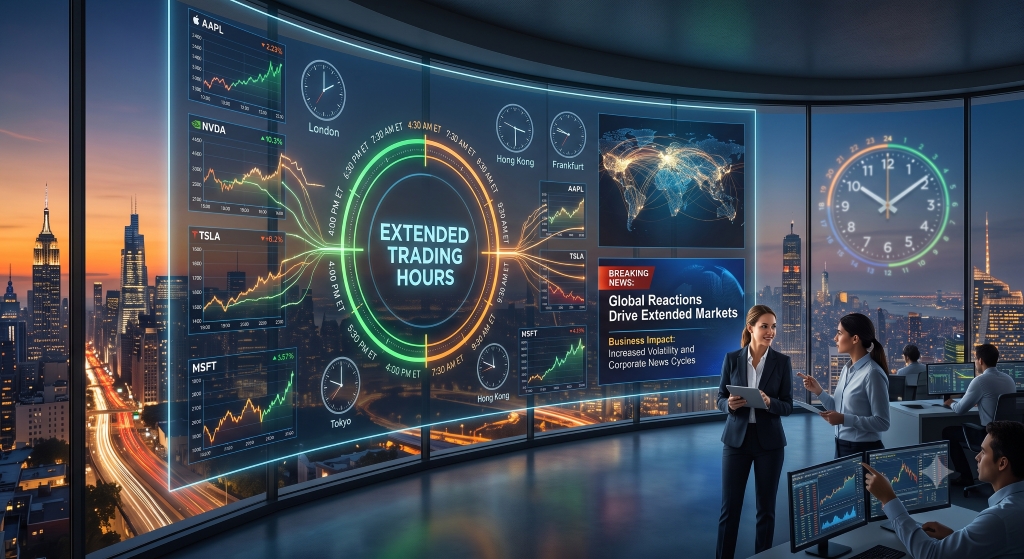
For decades, the financial world operated around a rigid schedule: the opening bell at 9:30 AM ET and the closing bell at 4:00 PM ET. But in today's hyper-connected, global economy, the market never truly sleeps.
The shift toward extended trading hours—comprising pre-market, after-hours, and emerging 24-hour trading sessions—is fundamentally changing how businesses raise capital, disclose critical earnings, and navigate market volatility.
1. Accelerated corporate news cycles & earnings reactions
Traditionally, companies released their earnings reports after 4:00 PM ET or before 9:30 AM ET to give analysts time to digest financial results before normal trading resumed. Extended trading hours have stripped away that cushion.
- Immediate market feedback. News breaks, and within seconds, stock prices adjust in extended-hours electronic communication networks (ECNs).
- Heightened volatility. Because extended trading sessions feature lower overall volume, individual trades can trigger sharper price swings. Executives now see market capitalization move dramatically before the regular opening bell even rings.
2. Democratization and global investor access
A major driver behind extended hours is global demand. An investor in Tokyo, London, or Sydney shouldn't have to stay up until 2:00 AM local time just to trade major U.S. equities.
- Access across time zones. Institutional and retail investors in Asia and Europe can react to overnight macro news, geopolitical developments, or commodity shifts in real time.
- Expanding liquidity pools. While off-hours volume is thinner, expanding access across global time zones gradually spreads trading volume across a continuous 24-hour cycle.
3. Operational & governance challenges for companies
While expanded access brings flexibility, it introduces new operational complexities for corporate leadership and investor relations teams:
The spread & price discovery gap. Extended hours carry wider bid-ask spreads and limited depth. A sudden price drop in overnight trading doesn't always reflect broad market sentiment, yet it can generate panic headlines before regular trading begins.
- Crisis communications. PR and IR teams must monitor sentiment around the clock rather than relying on standard market hours.
- Capital raising & offerings. Corporate actions, block trades, and secondary offerings require carefully timed execution windows to avoid trading illiquidity.
4. The path to 24/5 trading
Major exchanges are pushing toward continuous weekday trading. With major exchanges filing for SEC approvals to expand trading hours—including 22- to 23-hour daily operating models—the boundaries of standard financial markets are dissolving.
Businesses that adapt their financial communications, risk management, and trading capabilities to this continuous landscape will gain a distinct advantage in managing market efficiency and corporate value.
Further reading
| Resource | What you will learn |
|---|---|
| FINRA — Investor Insights | Official regulatory guidance on the risks, liquidity, and pricing rules of extended-hours trading. |
| NYSE — Extended Hours Trading | Updates from the New York Stock Exchange on expanded operating schedules and market data. |
| Fidelity Learning Center | Practical broker insights on order types, and pre-market and post-market execution rules. |
| Nasdaq Market Activity | Real-time market data with pre-market and after-hours activity trackers. |
Recommended industry links
Industry certification programs
- CFA — Chartered Financial Analyst · CFA Institute
- FRM — Financial Risk Manager · Global Association of Risk Professionals
- CAIA — Chartered Alternative Investment Analyst · CAIA Association
- CMT — Chartered Market Technician · CMT Association
- PRM — Professional Risk Manager · Professional Risk Managers' International Association (PRMIA)
- CQF — Certificate in Quantitative Finance · CQF Institute
- Canadian Securities Institute (CSI)
- Quant University LLC · Machine Learning & AI Risk Certificate Program
Industry software provider training
- SimCorp
- Charles River — Educational Services
Continuing education providers
- University of Toronto School of Continuing Studies
- Toronto Metropolitan University — The Chang School of Continuing Education
- Harvard University Online Courses
The study of art and its markets
- Sotheby's Institute of Art — knowledge of alternative investment in art
BA Blocks
- BA Blocks · BA Blocks YouTube Channel
This article is for educational and informational purposes only and should not be construed as financial advice.